
What Is Titanium Dioxide (TiO₂)? Types, Properties & Industrial Applications
- kanhakishorichemicalspvtltd@gmail.com
- No Comments
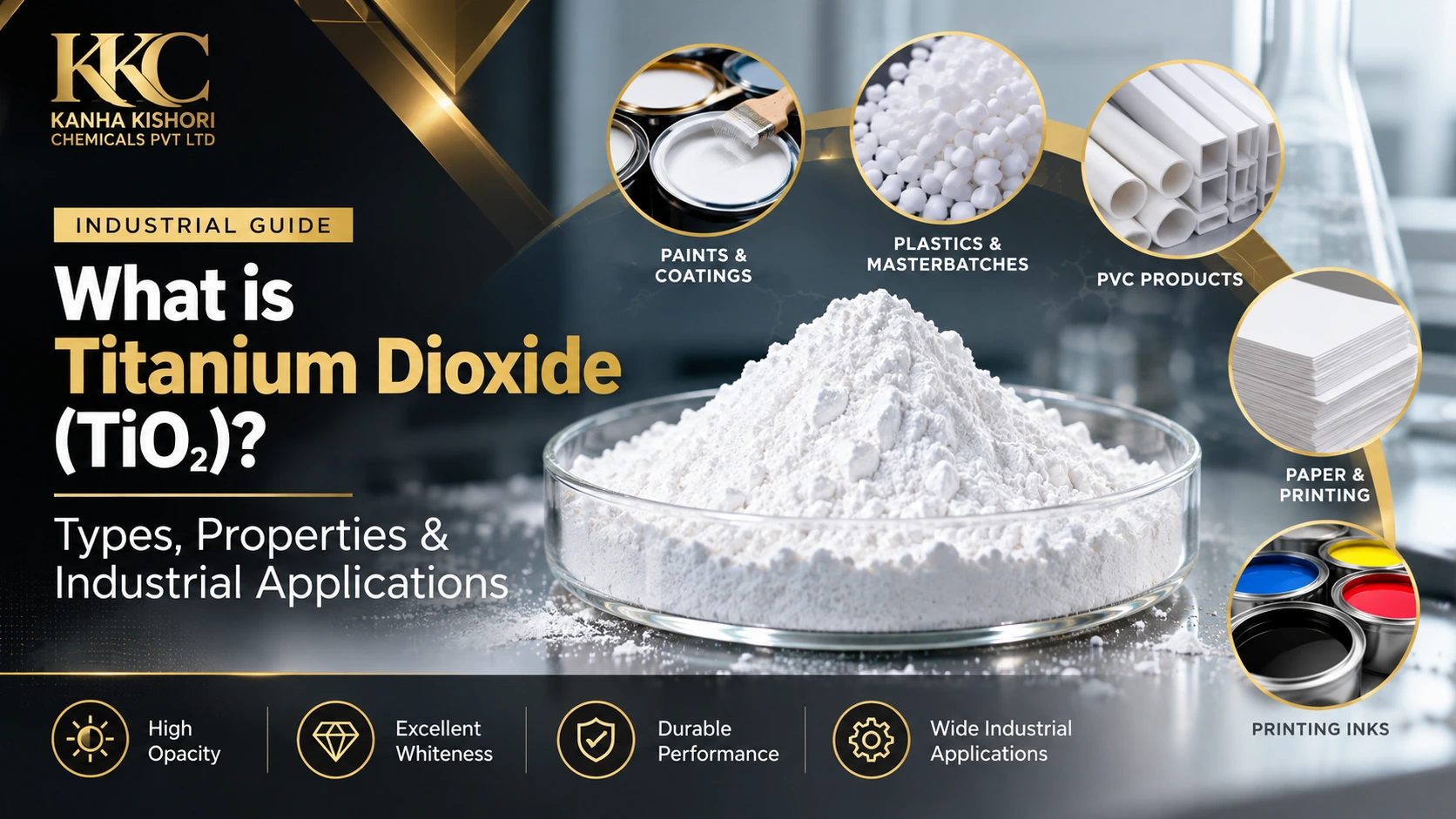
Titanium dioxide (TiO₂) is one of the most widely used white pigments in industrial manufacturing. From architectural paints and protective coatings to plastic products, masterbatches, paper, and printing applications, titanium dioxide plays an important role in improving whiteness, opacity, brightness, and visual consistency.
For manufacturers, selecting the appropriate titanium dioxide grade is more than a matter of choosing a white powder. Different grades are engineered for particular applications, processing conditions, durability requirements, and formulation objectives.
At Kanha Kishori Chemicals Pvt. Ltd., our industrial chemical product portfolio includes titanium dioxide grades from multiple manufacturers for applications in coatings, plastics, and related industries.
This guide explains what titanium dioxide is, its main types, key properties, production methods, industrial applications, and the factors buyers should consider when selecting a grade.
What Is Titanium Dioxide (TiO₂)?
Titanium dioxide is an inorganic compound consisting of titanium and oxygen, represented by the chemical formula TiO₂. It is also known as titanium(IV) oxide and, in pigment applications, titanium white.
In commercial pigment form, titanium dioxide is generally supplied as a fine white powder. Its most important characteristic is its high refractive index, which enables it to scatter visible light efficiently.
When properly dispersed in a suitable formulation, titanium dioxide can provide excellent whiteness, hiding power, and opacity. These properties make it an important ingredient in paints, coatings, plastic compounds, printing inks, and other industrial materials.
Unlike a soluble dye, titanium dioxide functions primarily as an insoluble particulate pigment. Its performance depends on characteristics such as particle size, crystal structure, surface treatment, and compatibility with the surrounding material.
Basic Properties of Titanium Dioxide
| Property | Description |
|---|---|
| Chemical formula | TiO₂ |
| CAS number | 13463-67-7 |
| Appearance | White solid; typically a fine powder in pigment form |
| Main commercial crystal forms | Rutile and anatase |
| Main function | White pigment and opacifying agent |
| Refractive index | Approximately 2.7 for rutile and 2.5 for anatase, depending on measurement conditions |
| Water solubility | Practically insoluble |
| Common applications | Paints, coatings, plastics, paper, inks, and other industrial products |
The exact specifications of commercial titanium dioxide products vary by grade and manufacturer.
Main Types of Titanium Dioxide
Titanium dioxide occurs in several crystal structures, including rutile, anatase, and brookite. For most industrial pigment applications, rutile and anatase are the two most relevant forms.
Although both have the same chemical formula, their crystal structures influence their optical properties, stability, and performance.
1. Rutile Titanium Dioxide
Rutile is widely used in industrial pigment applications, particularly where high opacity, durability, and weather resistance are important.
Its relatively high refractive index gives it excellent light-scattering ability. Appropriately surface-treated rutile pigments are commonly selected for exterior coatings, industrial paints, plastic masterbatches, and applications requiring long-term appearance retention.
Key advantages of rutile titanium dioxide include:
High opacity and hiding power
Excellent whiteness and brightness
Strong tinting performance
Good weatherability in suitably formulated products
Availability in application-specific grades
Rutile titanium dioxide is especially important in coatings and plastics because manufacturers can select grades optimized for gloss, dispersion, processing, and outdoor durability.
2. Anatase Titanium Dioxide
Anatase is another commercially important crystal form of titanium dioxide.
It is used in selected pigment applications, including certain indoor coatings and paper products. Anatase is also widely studied and used in specialized photocatalytic applications.
Compared with rutile, anatase has a lower refractive index and generally exhibits greater photocatalytic activity. This difference matters when selecting pigments for outdoor applications, where unwanted photocatalytic activity can contribute to degradation of surrounding organic materials.
Anatase may be suitable where its specific optical or functional characteristics are preferred.
Rutile vs Anatase Titanium Dioxide
| Feature | Rutile TiO₂ | Anatase TiO₂ |
|---|---|---|
| Crystal structure | Tetragonal rutile | Tetragonal anatase |
| Refractive index | Higher | Lower |
| Light-scattering potential | Generally higher | Generally lower |
| Outdoor pigment applications | Commonly preferred | More limited |
| Photocatalytic activity | Generally lower | Generally higher |
| Typical applications | Coatings, plastics, durable pigments | Selected indoor pigments, paper, specialty uses |
Important: Crystal form alone does not determine product performance. Particle size, coatings, dispersion, and the final formulation are also critical.
Important Properties of Titanium Dioxide in Manufacturing
High Opacity and Hiding Power
Opacity is the ability of a material to prevent the underlying surface from showing through.
Titanium dioxide is particularly effective at scattering visible light, which makes it useful in white and light-coloured formulations.
In paints, this can help provide better hiding of the substrate. In plastics, it can reduce transparency and help create a uniform appearance.
However, opacity depends on pigment concentration, particle spacing, dispersion quality, and the complete formulation.
Whiteness and Brightness
Titanium dioxide is widely used to produce bright white surfaces and improve the appearance of coloured materials.
For manufacturers, consistent pigment quality helps maintain colour standards between production batches.
Different grades may produce different undertones, brightness levels, and tinting behaviour. These differences can be important in applications with strict colour requirements.
Dispersion Performance
Good dispersion is essential for achieving the expected benefits of titanium dioxide.
Poorly dispersed pigment can create agglomerates, uneven colour, surface defects, and reduced optical efficiency.
Manufacturers should evaluate whether a grade is compatible with their mixing equipment, resin system, dispersants, and processing conditions.
Weather Resistance and Durability
Certain surface-treated rutile grades are developed for demanding exterior applications.
These grades can help maintain coating appearance and contribute to resistance against weather-related deterioration when used in an appropriately designed formulation.
Durability is not determined by titanium dioxide alone. Binder chemistry, stabilizers, formulation design, and exposure conditions also influence performance.
Industrial Applications of Titanium Dioxide
Titanium dioxide is used across numerous manufacturing sectors because it combines useful optical properties with a broad range of commercially available pigment grades.
1. Titanium Dioxide in Paints and Coatings
The paints and coatings industry is one of the major application areas for titanium dioxide.
It is used in architectural paints, industrial coatings, decorative finishes, and selected protective coating systems.
Titanium dioxide helps formulators achieve:
White and light-coloured finishes
Improved opacity and hiding power
Brightness and colour consistency
Desired gloss and appearance
Suitable weathering performance when the correct grade is selected
For example, coating-focused products such as Ti-Pure R-706 and Ti-Pure R-902+ are designed for applications where optical properties, dispersion, and durability must be balanced.
The correct selection depends on whether the coating is intended for interior or exterior use, its binder system, gloss requirements, and expected service conditions.
2. Titanium Dioxide in Plastics
Titanium dioxide is an important pigment in plastic manufacturing.
It is used in applications involving polyethylene, polypropylene, PVC, and other polymer systems.
Common objectives include improving whiteness, increasing opacity, controlling colour, and supporting the appearance of finished plastic products.
Typical applications include plastic packaging, sheets, profiles, moulded components, and other manufactured products.
Plastics-focused titanium dioxide grades must be evaluated for their dispersion behaviour, processing performance, and compatibility with the polymer.
For outdoor plastic products, weatherability and the complete stabilization system are particularly important.
3. Titanium Dioxide in Plastic Masterbatches
A masterbatch is a concentrated mixture of pigments or additives dispersed in a carrier resin.
Titanium dioxide is frequently incorporated into white masterbatches, which are subsequently mixed with polymer materials during manufacturing.
Masterbatch producers often consider pigment loading, melt flow, dispersion, filtration behaviour, and processing temperatures.
Grades such as Ti-Pure R-103, R-104, and R-105 are examples of titanium dioxide products developed for different plastics-related performance requirements.
Selecting the appropriate grade can help manufacturers achieve their target optical properties while maintaining efficient processing.
4. Titanium Dioxide in Paper and Printing Applications
Titanium dioxide is used in selected paper, decorative laminate, and printing-related applications where whiteness, brightness, or opacity is required.
In these applications, the pigment’s optical performance and compatibility with the production process are important.
Different paper and laminate formulations may require specialized grades with particular dispersion and surface characteristics.
Manufacturers should consult the relevant technical documentation before choosing a grade.
5. Titanium Dioxide in Printing Inks
Titanium dioxide can serve as a white pigment in suitable printing ink formulations.
Its light-scattering properties can help improve opacity and the visibility of printed designs on coloured or transparent substrates.
Ink formulators may need to evaluate pigment dispersion, viscosity, particle characteristics, and abrasion behaviour.
The preferred grade depends on the printing technology, substrate, binder system, and desired finish.
How Is Titanium Dioxide Manufactured?
Industrial pigment-grade titanium dioxide is primarily manufactured using two commercial processes: the sulfate process and the chloride process.
Sulfate Process
The sulfate process uses titanium-bearing raw materials and sulfuric acid to produce titanium dioxide through several chemical treatment, purification, and thermal processing stages.
Depending on the production route, it can produce rutile or anatase pigments.
The resulting pigment undergoes further processing to achieve the required physical and application properties.
Chloride Process
The chloride process involves converting suitable titanium-bearing feedstock into titanium tetrachloride, purifying it, and oxidizing it to produce titanium dioxide.
Commercial chloride-process pigment production is commonly associated with rutile grades.
After pigment formation, additional finishing operations may include particle-size control, surface treatment, washing, drying, and milling.
Does the Manufacturing Process Determine Quality?
Both processes can produce commercially useful titanium dioxide pigments.
A buyer should not assume that every chloride-process grade is automatically superior to every sulfate-process grade.
The correct comparison should consider the individual grade’s specifications, application suitability, processing characteristics, and performance in the intended formulation.
How to Choose the Right Titanium Dioxide Grade
Selecting titanium dioxide requires a clear understanding of the final product and its manufacturing conditions.
1. Identify the End Application
Start by identifying whether the pigment will be used in architectural coatings, industrial paints, plastic masterbatches, PVC products, printing inks, or another application.
A grade developed for plastic extrusion may not deliver the same performance in a water-based paint formulation.
2. Evaluate Optical Requirements
Determine the required whiteness, opacity, tinting strength, undertone, and gloss.
These properties influence both the visual appearance and the pigment efficiency of the final product.
3. Check Dispersion and Processing Compatibility
Consider the production equipment, resin or binder chemistry, operating temperatures, and dispersion method.
For plastics, melt-processing behaviour may be important. For coatings, wetting and dispersion in the selected binder system can be critical.
4. Consider Durability Requirements
For exterior products, evaluate the grade’s weatherability and suitability for UV-exposed applications.
Use manufacturer technical data and application testing rather than relying only on general product descriptions.
5. Review Technical Documentation
Before purchasing industrial titanium dioxide, buyers should request relevant technical documents.
These may include:
Technical Data Sheet (TDS)
Safety Data Sheet (SDS)
Certificate of Analysis (COA), where available
Packaging and storage information
Grade-specific specifications
Applicable regulatory or compliance information
A technical comparison and, where appropriate, production trials can help reduce the risk of selecting an unsuitable grade.
Titanium Dioxide Product Portfolio at Kanha Kishori Chemicals
Kanha Kishori Chemicals Pvt. Ltd. is a Delhi-based industrial chemical trading and supply company with a product portfolio covering titanium dioxide, carbon black, fillers, additives, pigments, and other industrial raw materials.
The company’s titanium dioxide catalogue includes grades associated with manufacturers and product lines such as:
Chemours Ti-Pure: R-103, R-104, R-105, R-706, R-900, and R-902+
KRONOS: R-2360, R-2220, R-2190, and other listed grades
Tronox: CR-595, CR-826, and CR-828
Venator: TR-92, TR-28, TR-42, and other listed grades
LB Group: BLR-698, BLR-886, BLR-895, BLR-896, and BLR-996
Other listed product lines: Jinhai, Pangang, KMML, Dawn, and additional manufacturers
This catalogue gives industrial buyers a range of products to enquire about for different formulation requirements.
Product availability, specifications, packaging, and commercial terms should be confirmed directly with KKC before placing an order.
Why Grade Selection Matters for Industrial Buyers
The lowest quoted price does not always represent the most economical pigment choice.
A lower-cost grade may require different loading levels or additional formulation adjustments to achieve the desired performance.
For industrial purchasing teams, the total evaluation should include pigment efficiency, processing compatibility, finished-product quality, consistency, documentation, and procurement requirements.
When comparing grades, it is useful to perform controlled application trials and evaluate results under consistent conditions.
A technically appropriate titanium dioxide grade can help manufacturers balance product quality, formulation performance, and production cost.
Frequently Asked Questions About Titanium Dioxide
1. What is titanium dioxide mainly used for?
Titanium dioxide is mainly used as a white pigment and opacifying agent in products such as paints, coatings, plastics, paper, and printing inks. It provides whiteness, brightness, and light-scattering performance.
2. What is the difference between rutile and anatase titanium dioxide?
Rutile and anatase are different crystal forms of TiO₂. Rutile has a higher refractive index and is generally preferred for durable pigment applications, while anatase is used in selected indoor pigment and specialty applications.
3. Is titanium dioxide suitable for plastic manufacturing?
Yes. Appropriate titanium dioxide grades are widely used in plastic products and masterbatches to improve whiteness, opacity, and appearance. Grade selection should consider the polymer, processing conditions, and intended application.
4. Which titanium dioxide grade is best for paints?
There is no single best grade for every paint. The choice depends on the coating type, binder system, gloss, opacity, dispersion, durability, and cost-performance requirements.
5. What is the difference between chloride-process and sulfate-process titanium dioxide?
These are two industrial production routes for titanium dioxide. Both can produce useful pigment grades, but the resulting products differ according to their manufacturing and finishing specifications.
6. Where can industrial buyers enquire about titanium dioxide grades in India?
Industrial buyers can contact chemical trading and supply companies such as Kanha Kishori Chemicals Pvt. Ltd. to enquire about listed titanium dioxide grades, product documentation, availability, and quotation details.
Conclusion
Titanium dioxide is an essential white pigment for numerous industrial applications. Its ability to provide opacity, brightness, whiteness, and suitable appearance makes it valuable in coatings, plastics, masterbatches, paper, and printing-related products.
However, not all titanium dioxide grades are interchangeable.
Understanding the differences between rutile and anatase, manufacturing processes, surface treatments, dispersion behaviour, and end-use requirements is important for choosing the right material.
For manufacturers and procurement teams, the most effective approach is to compare technical specifications and evaluate grades against the requirements of the final product.
Looking for Titanium Dioxide for Your Industrial Application?
Explore Titanium Dioxide Grades with Kanha Kishori Chemicals Pvt. Ltd.
Whether you are sourcing titanium dioxide for paints, coatings, plastics, or masterbatch manufacturing, KKC’s product catalogue provides a starting point for identifying relevant grades.
Contact our team to discuss your required manufacturer, product grade, application, quantity, and documentation needs.
Website: https://kanhakishorichemicals.com/
Email: kanhakishorichemicalspvtltd@gmail.com
Enquire about product availability and request a quotation through our website.